Showing posts with label Merapi Volcano. Show all posts

Sunday, November 21, 2010

Mount Merapi Still Blowing off Steam

No comments:
Merapi Volcano on November 10, 2010, when the Moderate Resolution Imaging Spectroradiometer (MODIS) on NASA’s Terra satellite. Credit: NASA
For about three weeks, Indonesia’s Mount Merapi has been belching out lava, as well as ash and gas, clouding the atmosphere above. This satellite image, taken by NASA’s MODIS instrument on the Terra satellite, shows the volcano now settling down and is the most cloud-free satellite view of the volcano that we’ve been able to see. Thick ash is still rising and the volcano is still considered to be erupting at dangerous levels. Merapi is one of Indonesia’s most active volcanoes, and this eruption has been the most violent since the 1870′s.
The dark brown streak down the southern face of the volcano is ash and other volcanic material deposited by a pyroclastic flow or lahar. The volcano has been blamed for 156 deaths and about 200,000 people had to evacuate. The ash also caused flights to be delayed or canceled.
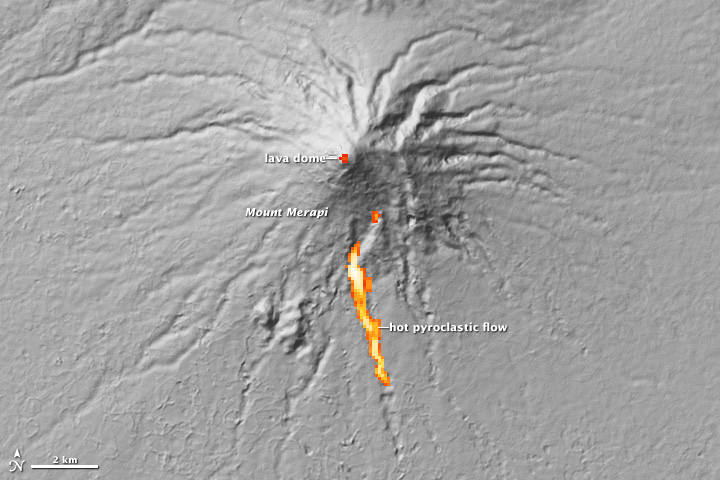
See below for a thermal image of the lava flow.

The Advanced Spaceborne Thermal Emission and Reflection Radiometer (ASTER) on NASA’s Terra satellite captured the thermal signature of hot ash and rock and a glowing lava dome on Mount Merapi on Nov. 1, 2010. Credit: NASA.
As a very active volcano, Merapi poses a constant threat to thousands of people in Indonesia. The Advanced Spaceborne Thermal Emission and Reflection Radiometer (ASTER) on NASA’s Terra satellite captured the thermal signature of hot ash and rock and a glowing lava dome. The thermal data is overlaid on a three-dimensional map of the volcano to show the approximate location of the flow. The three-dimensional data is from a global topographic model created using ASTER stereo observations.
For more information see NASA’s Earth Observatory website.

Indonesia volcano death toll rises

No comments:
Rescuers scoured Merapi's slopes for survivors as scientists warned of more eruptions to come [GALLO/GETTY]
Indonesia's Mount Merapi has begun to erupt, spewing searing clouds of volcanic ash and rocks into the sky, killing at least 29 people.
One of those who died on Tuesday was a baby who suffered breathing problems, while dozens more people have been injured.

Surono, the government's chief volcanologist, said the mountain, which had been rumbling for hours, started to erupt just before dusk, a day after the agency raised the alert status to the highest level.

"We heard three explosions around 06:00 pm (1100GMT) spewing volcanic materials as high as 1.5 km upward and heatclouds down on the slopes," Surono, who like many Indonesians goes by only one name, told the AFP news agency.

Indonesian scientists had warned of a pressure build-up beneath Mount Merapi's lava dome, as authorities evacuated tens of thousands of villagers to temporary shelters.
Rock avalanche
An avalanche of rocks spilled down Merapi's slopes before dawn on Tuesday and gusts of ash rose 50 metres into the air as the mountain continued to rumble.
Surono had said earlier that the greatest concern was pressure building behind a massive lava dome that has formed near the tip of the crater.
"The energy is building up. ... We hope it will release slowly," he said.
"Otherwise, we're looking at a potentially huge eruption, bigger than anything we've seen in years."
Temporary shelters were set up after officials designated an area 10km around the country's most active volcano a danger zone.
More than 50,000 people living in the shadows of the volcano, located north of the Javanese cultural capital, Jogjakarta, are now facing evacuation.
Widi Sutikno, a field co-ordinator in the Sleman district on the southern slopes of the 2,914-metre mountain, said about 3,700 people had already moved to makeshift camps.
"We have evacuated many women, pregnant women, sick people, elderly people and children," Sutikno said.
"We let some people return to their fields for their daily activity. But they need to go back to the camps and not their houses."
Huge panic
Step Vassen, Al Jazeera's correspondent close to Mount Merapi, said: "There was huge panic of course when the eruption was taking place.
"Two women are in hospital with severe wounds due to the hot gas clouds that came down from the mountain that can reach 600 degrees Celsius, so they are very dangerous.
"Now thousands of people are running away, they are trying to find a safer place. They are going to the refugee centres that have been set up by the government."
Vassen said that as Merapi is the most active volcano in the country residents were reluctant to leave for fear of leaving homes and livestock unattended for a false alarm.
Merapi last erupted in 2006, when it sent an avalanche of pyroclastic ash - hot gases and rock fragments - racing down the mountain which killed two people.
A similar eruption in 1994 killed 60 people, while 1,300 people died in an eruption in 1930.
There are more than 129 active volcanoes in Indonesia, which are spread across 17,500 islands and prone to eruptions and earthquakes due to its location within the so-called Ring of Fire.
The ring comprises a series of fault lines stretching from the western Hemisphere through Japan and Southeast Asia.

Official warns of Mt. Merapi eruption

No comments:
Eruption: Mt. Merapi eruption in 2006. -- AP 
Eruption: Mt. Merapi eruption in 2006. -- AP
Mt. Merapi in Yogyakarta may erupt in a more explosive way than its previous eruptions, head of the Volcanology and Geological Disaster Mitigation Center, Surono, warns.

Surono said the center was aware of the pattern of the volcano’s eruption, but history told that the magnitude of the explosion was sometimes unpredictable.

“Merapi tends to form a lava dome before it erupts, but our data shows there was an explosive eruption without prior formation of a dome,” Surono said as quoted by Antara news agency on Friday night.

Deviation of the eruption pattern took place in 1930 and 1931, which Surono said affected areas in a radius of over 15 kilometers from the peak. “It caused an ash rain that reached as far as Malang and Madura Island in East Java,” he added.

The center increased on Friday the volcano’s alert status to the second highest level following its increasing volcanic activities.

Surono said he could predict when Mt. Merapi would explode despite its fast increasing activities. “For sure, however, Merapi has never broken its promise. Eruption, whether explosive or not, will cap its volcanic activities,” he said.

Mount Merapi's eruptions

No comments:
Since its initial eruptions on October 25th, Indonesia's Mount Merapi continues to spew hot gases and ash as far as 5,000 meters into the atmosphere, wreaking havoc on surrounding villages and farms, and disrupting air travel - and more than 140 people have been killed by the eruptions over the past two weeks. Hundreds of thousands of residents have been displaced, many of them living in temporary shelters until the Indonesian government reduces the existing 20 km "safe zone", and allows them and their livestock to return. Collected here are recent images from the area near the unpredictable Mount Merapi as it still rumbles and erupts. (39 photos total)

A farmer stands in a rice field as volcanic material from Mount Merapi erupts, in Klaten, Central Java on November 4, 2010 near Yogyakarta, Indonesia. Over 70,000 people have now been evacuated with the danger zone being extended to over 15km as the volcano continues to spew ash and volcanic material. (Ulet Ifansasti/Getty Images)

Mount Merapi volcano spews smoke as seen from Deles village in Klaten, near the ancient city of Yogyakarta, November 1, 2010. (REUTERS/Dwi Oblo) #

Houses are in flames as volunteers rescue burned victims of an eruption of Mount Merapi in Argomulyo village early on November 5, 2010. (SUSANTO/AFP/Getty Images) #

Volunteers rescue burned victims of Mount Merapi eruption in Argomulyo village, devastated by deadly hot clouds of volcanic ash early on November 5, 2010. (SUSANTO/AFP/Getty Images) #

Lightning strikes as Mount Merapi erupts, as seen from Ketep village in Magelang, Indonesia's Central Java province November 6, 2010. (REUTERS/Beawiharta) #

Dead trees and ash cover a damaged house with the erupting Mount Merapi in the background in Sleman, Yogyakarta province, central Java, on November 6, 2010. (BAY ISMOYO/AFP/Getty Images) #

A pair of shoes sit covered in volcanic ash from the eruption of Mount Merapi in the abandoned village of Kaliadem, Yogyakarta, Indonesia on Nov. 2, 2010. (AP Photo/Trisnadi) #

Survivor Sri Sucirathaasri, 18, stands beside her injured sister Prisca in a hospital in Yogyakarta, Indonesia on Nov. 5, 2010. The hospital at the foot of Indonesia's most volatile volcano is struggling to cope with victims brought in after the mountain's most powerful eruption in a century. (AP Photo/Achmad Ibrahim) #

Villagers gather at the grave of the victims of Mount Merapi eruption for a mass burial at Sleman, Yogyakarta, Indonesia, Sunday, Nov. 7, 2010. (AP Photo/Achmad Ibrahim) #

A villager takes a stroll at Ketep village in Magelang, Indonesia's Central Java province, November 6, 2010, as Mount Merapi volcano erupts spewing out towering clouds of hot gas and debris in the background. (REUTERS/Beawiharta) #

Dead trees and mud clog a river as clouds of hot ash spew from the erupting Mount Merapi in Sleman, central Java, on November 6, 2010. (BAY ISMOYO/AFP/Getty Images) #

Volcanic ash from the eruption of Mount Merapi covers a village in Muntilan, Central Java, Indonesia, Sunday, Nov. 7, 2010. (AP Photo/Trisnadi) #

A search and rescue team looks for victims at Wukirsari village in Sleman district in the Indonesian Central Java province November 7, 2010. (REUTERS/Sigit Pamungkas) #

A kitchen is covered by ash in Cangkringan village off the Indonesia's Central Java province, November 6, 2010. (REUTERS/Dwi Oblo) #

A pet bird, killed during the eruption of Mount Merapi, lies in its cage in the abandoned village of Kaliadem, Yogyakarta, Indonesia on Nov. 2, 2010. (AP Photo/Trisnadi) #

A melted radio-cassette tape recorder sits covered with volcanic ash from the eruption of Mount Merapi in the abandoned village of Kaliadem, Yogyakarta, Indonesia on Nov. 1, 2010. (AP Photo/Trisnadi) #


Warning:
This image contains graphic
or objectionable content

click here to view it.
Bodies of victims of an eruption of Mount Merapi rest amongst ashes and debris in front of a house in Argomulyo village, Cangkringan, in Sleman November 5, 2010. (REUTERS/Aditia Surya) #


Warning:
This image contains graphic
or objectionable content

click here to view it.
Rescuers remove the charred remain of the body of a victim of Mount Merapi eruption in Argomulyo, Yogyakarta, Indonesia, Friday, Nov. 5, 2010. (AP Photo/Trisnadi) #

An Indonesian veterinarian tends to a cow injured after Mouth Merapi's eruption in the village of Umbulharjo, in Sleman, central Java, on October 29, 2010. (ADEK BERRY/AFP/Getty Images) #

Molten lava flows from the crater of Mount Merapi captured in this long exposure photograph taken from Klaten district in Central Java province late on November 2, 2010. (SONNY TUMBELAKA/AFP/Getty Images) #

Mount Merapi spews lava and smoke as it erupted again on Wednesday as seen from Sidorejo village in Klaten on November 3, 2010. (REUTERS/Beawiharta) #

Residents ride their motorcycles in Yogyakarta, blanketed by volcanic ash falling from Mount Merapi's latest eruption early on October 30, 2010. (CLARA PRIMA/AFP/Getty Images) #

A woman wearing a raincoat, rides a bicycle on an ash-covered road after another eruption of Mount Merapi volcano, in the city of Yogyakarta October 30, 2010. (REUTERS/Andry Prasetyo) #

Villagers flee their homes following another eruption Mount Merapi in Klaten ,Indonesia, Friday, Nov. 5, 2010. (AP Photo/Achmad Ibrahim) #

Mount Merapi erupts, as seen from Wukirsari village in Sleman, near the ancient city of Yogyakarta, November 4, 2010. (REUTERS/Beawiharta) #

Stumps are all that remain of trees felled by an eruption of Mount Merapi, at Kinahrejo village in Sleman, Indonesia on October 27, 2010. (Ulet Ifansasti/Getty Images) #

Residents leave a danger zone as Merapi volcano releases ash clouds above Balerante village, Klaten on November 1, 2010. (ADEK BERRY/AFP/Getty Images) #

Villagers escorted by police carry a suspected looter caught in an abandoned village in Sleman located in Mount Merapi's danger zone on November 1, 2010. (ARYA BIMA/AFP/Getty Images) #

Indonesian soldiers of Special Force of Kopassus evacuate an elderly woman who refuses to leave her home during an evacuation after a new violent explosion in Umbulharjo, Sleman on October 30, 2010. (ADEK BERRY/AFP/Getty Images) #

A woman prays in a temporary shelter at Maguwoharjo Stadium in Yogyakarta, November 5, 2010. (REUTERS/Beawiharta) #

Refugees rummage through second-hand clothes that were distributed at a refugee camp in Yogyakarta, Central Java November 7, 2010. (REUTERS/Sigit Pamungkas) #

A girl weeps at a temporary shelter for those who are affected by the eruption of Mount Merapi in Bawukan, Indonesia, Friday, Nov. 5, 2010. (AP Photo/AK Hendratmo) #

Refugees look out from inside a tent during rain at a temporary evacuation center set up as a result of the repeated eruptions of Mount Merapi, in Keputran village, Klaten, Central Java on November 4, 2010. (Ulet Ifansasti/Getty Images) #

Lava and ash spews from the top of Mount Merapi, viewed from Klaten district in Central Java province before dawn on November 6, 2010. (BAY ISMOYO/AFP/Getty Images) #

A view from a domestic flight from Denpasar to Yogyakarta that was subsequently diverted to Surabaya airport shows a plume of gas and ash billowing some 10 km (six mi) high from Mount Merapi, during an eruption on November 4, 2010. (CLARA PRIMA/AFP/Getty Images) #

Search and rescue team members from Yogyakarta carry a victim of Merapi volcano's eruption at the village of Ngancar in Sleman on November 8, 2010. (CLARA PRIMA/AFP/Getty Images) #

The hand of a victim of the eruption of Mount Merapi, among body bags at a hospital morgue in Yogyakarta, Indonesia, Friday, Nov. 5, 2010. (AP Photo/Slamet Riyadi) #

A farmer walks through his corn field covered in volcanic ash from Mount Merapi eruption in Muntilan, Central Java, Indonesia on Monday, Nov. 8, 2010. (AP Photo) #

Mount Merapi, viewed from Sidorejo village in Klaten on November 1, 2010. (REUTERS/Beawiharta) #

Merapi is the bridge between Web and Desktop software

No comments:
Merapi, a project run by the team at Roundarch Labs, has been a long time in the making, but on July 14th, 2008 the initial Merapi Alpha release candidate was distributed to the Merapi Alpha community of users.
On Wednesday, May 20th, Merapi is officially Open Source! After almost a year of  heavy development, we have finally released Merapi's Java-to-AIR bridge framework as Open Source, and are hosting the project on Google Code.
Merapi is a technology that can be used as a messaging bridge between applications that run in the Adobe Flash player or Adobe AIR and applications written in Java.
This is really exciting to the Java, Adobe Flex and Adobe AIR development communities and everyone on the Merapi team is excited as can be to start working with this larger community group to uncover bugs, add features and shape the concept of Merapi into the backbone of killer applications across the globe. Since the initial release, the community has provided a lot of feedback to the Merapi team, and the industry has started to take notice of what we are doing, and what Merapi can be used for.
While we are working hard to improve the core functionality and developer experience when using Merapi, members of the Merapi project team are constantly out an about at conferences, user groups, talking to developers,  analysts and members of the "Web" media about what we are doing and about how Merapi can be used to create fundamental changes in the way we design and develop software applications.
For more information about Merapi, how you can use it, how it is being used, and what it means for the future of Web and Desktop software development, we suggest you check out the information posted on this Web site, by searching Google,  reading through the Merapi Project forums, or by checking out some of the Merapi project member's own personal Web sites: Adam Flater (founder, architect) - adamflater.net, Dave Meeker (chief project instigator) - whatanexperience.org, or these other blogs/postings.
To learn more about Roundarch, check out our old (and soon to be re-launched) Web site - roundarch.com.
We will soon be re-designing this Web site, and encourage you to still sign up and create an account. Doing so will allow us to provide you with updates on Merapi and other next-generation technologies developed/supported by Roundarch Labs. To sign up as a member of the Merapi Project Web site. Once we receive your request, we will approve your account and you will get an automated email with your account credentials and other information.

Wednesday, November 17, 2010

Merapi eruption forces Indonesia flight cancellations

No comments:
Cannot play media.You do not have the correct version of the flash player. Download the correct version
Mount Merapi continues to bellow plumes of hot ash

Related stories

International airlines have cancelled flights to airports near Mount Merapi, as Indonesia's most volatile volcano continues to pump out clouds of ash.
Some flights from Singapore and Malaysia were cancelled, and the Indonesian government warned other airlines to avoid some routes because of the ash.
At least 38 people have been killed since Merapi began erupting last week.
Scientists have warned that the volcano could continue rumbling for some time.
"It could go on for weeks, even months," vulcanologist Subandrio told AFP news agency.
Early on Tuesday, boiling red lava was clearly visible in the crater of the volcano, which lies about 20 miles (30km) from the city of Yogyakarta.
Several times after dawn, huge clouds of ash and debris shot out from Merapi.
The slopes of the mountain and nearby areas are covered with grey ash, while almost 70,000 residents remain in government shelters.
AirAsia, which is based in Malaysia, cancelled four flights from Kuala Lumpur to Yogyakarta and nearby Solo, while Silk Air cancelled two flights between Singapore and Solo.
Both airlines said they were watching the situation carefully.
Transport ministry spokesman Bambang Ervan said airlines had been told to "use an alternative route for safety reasons due to the volcanic ash", AFP news agency reported.
Some domestic flights have already had to be rerouted to other airports, the Jakarta Post reported.

Merapi Review

No comments:
Merapi Photo
Country:Indonesia
Subregion Name:Java (Indonesia)
Volcano Number:0603-25=
Volcano Type: Stratovolcano
Volcano Status:Historical
Last Known Eruption: 2007 
Summit Elevation: 2968 m 9,737 feet
Latitude: 7.542°S 7°32'30"S
Longitude: 110.442°E 110°26'30"E

Merapi, one of Indonesia's most active volcanoes, lies in one of the world's most densely populated areas and dominates the landscape immediately north of the major city of Yogyakarta. Merapi is the youngest and southernmost of a volcanic chain extending NNW to Ungaran volcano. Growth of Old Merapi volcano beginning during the Pleistocene ended with major edifice collapse perhaps about 2000 years ago, leaving a large arcuate scarp cutting the eroded older Batulawang volcano. Subsequently growth of the steep-sided Young Merapi edifice, its upper part unvegetated due to frequent eruptive activity, began SW of the earlier collapse scarp. Pyroclastic flows and lahars accompanying growth and collapse of the steep-sided active summit lava dome have devastated cultivated lands on the volcano's western-to-southern flanks and caused many fatalities during historical time. The volcano is the object of extensive monitoring efforts by the Merapi Volcano Observatory.

Indonesia: This volcano brought to you by Philip Morris

No comments:
YOGYAKARTA, Indonesia — Nobody is allowed to smoke in the Sampoerna Rescue camp.
The cluster of leaky, ash-covered canvas tents that has been set up in a muddy field here, on the slopes of erupting Mount Merapi in Central Java, has been designated a smoke-free zone by volunteers and employees of Sampoerna, one of Indonesia’s largest tobacco companies.
The camp is one of the only places here in Java, where almost two-thirds of adult males are addicted to cigarettes, and where smoking is tolerated everywhere from airport lounges to children’s play parks, that you can’t smoke.
The company, which has been owned by Philip Morris since 2005, paid for the camp, the flashy four-wheel drive vehicles parked in front of it, and the cluster of eager staffers wearing natty red and black uniforms covered with company logos. The team is one of several emergency response efforts organized by large Indonesian corporations in response to the devastating series of eruptions that have so far killed more than 100 people and displaced more than 150,000 rural residents in the last week.
On Thursday, as the volcano unleashed its biggest explosion yet — only to be dwarfed by another explosion Friday that more than doubled the death toll — the mountainside crawled with expensive ambulances, water purification trucks and four-wheel-drive vehicles, all provided by the companies.
Businesses as diverse as Jakarta-based conglomerate Artha Graha, telecommunications giant Telkomsel and state oil company Pertamina provided the vehicles, which, like the uniforms of the squads of employees who operate them, are typically emblazoned with corporate logos.
Known here as “corporate social responsibility” efforts, the disaster relief teams aim to augment efforts by a stretched Indonesian government to house, clothe and feed evacuees from the volcano. Representatives of the companies working on the mountain said their efforts are entirely altruistic, and balked at any suggestion that the aid teams double as a marketing campaign for the companies.
But local residents and evacuees were not so sure.
“Why can’t they just do the good stuff, but without the advertising?” asked 18-year-old Anin, who like many Indonesians only uses one name and who was volunteering at an evacuation camp opposite the Sampoerna camp in her home village of Harjobinangung. “Why can’t they just use plain white vehicles or something?”
Earlier this week, police and military officers tore down hundreds of banners and advertisements for political parties that had quickly sprung up on main streets in the evacuation zone. The removal of the advertisements, which had rankled local residents and evacuees, came after a local official announced that they had been erected without permits.
Aprilianto, a 31-year-old evacuee from the slopes north of Harjobinagung, said the government should apply the same rules to private companies that have erected banners and tents displaying their corporate logos.
“The companies are taking advantage of the situation, so why should they be treated differently?” Aprilianto said.
Inside one of the Sampoerna tents, Herman Sudjarwo, a general practitioner who usually works in a private hospital in the city of Surabaya in East Java, attended to evacuees in a makeshift clinic. He said most of the 90 to 100 patients he sees a day are suffering from breathing difficulties attributable to the high levels of volcanic ash and dust that have rained down from the volcano’s crater.
Asked whether he sees any irony in a cigarette company providing free medical checkups, Sudjarwo giggled.
“This is to balance it out,” he said.
Arief Triastika, a national coordinator for Sampoerna’s community development efforts, who has been managing the camp on Merapi, said his company is only interested in providing assistance to people affected by the volcano and is not using the disaster as a promotional opportunity.
Sampoerna maintains three disaster management teams on the island of Java and has dispatched crews of volunteers to disasters all over Indonesia since 2002, Triastika said. The company has helped provide food, medical equipment and logistical aid to victims of the 2004 Indian Ocean earthquake and tsunami, the 2006 tsunami in West Java, earthquakes in Padang and Yogyakarta and floods across Java in 2010, he said.
Asked if skeptical evacuees have criticized his efforts, Triastika shook his head vigorously.
“At the moment we don’t have that criticism. And we keep giving the best we can do for the community,” he said.
When employees and volunteers want to smoke at the Sampoerna Rescue camp, they have to leave the tents, even if it is pouring with rain, Triastika said. The camp is a de facto medical clinic, he said, and therefore must be kept sterile.
Locals eyeing the tents and the Sampoerna banners from an evacuation camp across the street had other ideas about the Sampoerna effort, however.
Asked if he had ever thought to approach the camp volunteers for free cigarettes (the company does not hand out cigarettes), Aprilianto’s eyes lit up.
“No,” he said as he stubbed out a rival brand’s clove cigarette. “Do they do that?”

Monday, November 15, 2010

Mount Merapi erupts, 20 hurt by hot ash

No comments:
Indonesia's most volatile volcano started erupting Tuesday, after scientists warned that pressure building beneath its dome could trigger the most powerful eruption in years.
Up to 20 people were injured by hot ash spewed from Mount Merapi, said an AP reporter who witnessed them being taken away for treatment.
Subandriyo, chief vulcanologist in the area, said the eruption started just before dusk Tuesday. The volcano had rumbled and groaned for hours.
"There was a thunderous rumble that went on for ages, maybe 15 minutes," said Sukamto, a farmer who by nighfall had yet to abandon his home on the mountain's fertile slopes. "Then huge plumes of hot ash started shooting up into the air."
Scientists have warned that pressure building beneath Merapi's lava dome could trigger one of the most powerful blasts in years.
"The energy is building up. ... We hope it will release slowly," government volcanologist Surono told reporters. "Otherwise we're looking at a potentially huge eruption, bigger than anything we've seen in years."
The alert level for the 9,737-foot (2,968-metre) mountain has been raised to its highest level.
Some 11,400 villagers on the mountain were urged to evacuate. But most who fled were the elderly and children, while adults stayed to tend to homes and farms on the mountain's fertile slopes.
In 2006, an avalanche of blistering gases and rock fragments raced down the volcano and killed two people. A similar eruption in 1994 killed 60 people, and 1,300 people died in a 1930 blast.
Indonesian officials were also trying to assess the impact of a 7.7-magnitude earthquake late Monday that caused a tsunami off western Indonesia, leaving scores of villagers dead or missing.
Indonesia is a vast archipelago of 237 million people, and the volcano and earthquake epicenter are about 8,000 miles (13,000 kilometers) apart. The nation is prone to earthquakes and volcanic activity due to its location on the so-called Pacific Ring of Fire - a series of fault lines stretching from the Western Hemisphere through Japan and Southeast Asia.
There are more than 129 active volcanoes to watch in Indonesia, which is spread across 17,500 islands.

Mount Merapi

No comments:
Mount Merapi is located in the subduction zone, where the Indo-Australian Plate is going under the Eurasian Plate. Geologists estimate that the volcano started forming 400,000. It was largely built up by basaltic lava flows, but the lava flows have become more viscous in the last 10,000 years or so. With the thicker lava, Merapi has had more explosive eruptions and the formation of lava domes. Merapi has minor eruptions every 2 years or so, and major eruptions every few decades.
Even though it’s an extremely active volcano, thousands of people live on its flanks. Hot gas killed 43 people in 1994, and 13 villages and 1400 people were killed by pyroclastic flows during an eruption in 1930. A series of earthquakes struck Mount Merapi in April/May 2006, the most powerful one on May 27th killed 5,000 people. An eruption on June 14, 2006 spewed out a cloud of volcanic ash that covered a village several kilometers away.
We have written many articles about volcanoes for Universe Today. Here’s an article about Mount Pinatubo, and here’s an article about Mount Tambora.
Want more resources on the Earth? Here’s a link to NASA’s Human Spaceflight page, and here’s NASA’s Visible Earth.
No comments:
Of the 130 active volcanoes in Indonesia, Merapi is the most active, and has had at least twelve eruptions that killed people. The name Merapi means "Mountain of Fire". The volcano is considered sacred and every year a priest climbs to the top to make an offering.
High 2968 meters, it is located 25 km north of Yogyakarta.
The mountain erupts about once every 5.5 years and has killed as many as 1,600 people in 26 eruptions since 1930.


Merapi Volcano

No comments:
merapi
John Seach at summit of Merapi Volcano.


Merapi volcano is one of the world's most active and dangerous volcanoes. It contains an active lava dome which regularly produces pyroclastic flows. Eruptions occur at intervals of 1-5 years and are of low gas pressure. Since magma is poor in gas, eruptions are usually less than VEI 3 in size.

Merapi is one of the most active volcanoes in Indonesia and has produced more pyroclastic flows than any other volcano in the world. It has been active for 10,000 years.


Most eruptions of Merapi involve a collapse of the lava dome creating pyroclastic flows which travel 6 to 7 km from the summit. Some awan panas have traveled as far as 13 km from the summit, such as the deposit generated during the 1969 eruption. Velocity of pyroclastic flows can reach up to 110 km/hour. A slow up flow of andesitic magma leads to an extrusion of viscous magma, which accumulate and construct a dome in the crater.

Violent Eruptions at Merapi volcano
There is evidence that the current low level of activity may be interrupted by larger explosive eruptions. Eruptions of Merapi volcano during the 7–19th centuries A.D. were more violent than the past hundred years, and produced explosion pyroclastic flows. Widespread pyroclastic flows and surges traveled up to 25 km down the flanks of Merapi.

Scientists predict that the quiet of the 20th century will be broken by a larger
explosive eruption within coming decades. (Scientific report published in 2000).

2010 Eruption
Merapi volcano began erupting on 26th October 2010. The eruption was the was the largest at the volcano in 100 years. Ash emissions reached an altitude of 40,000 ft, and 370,000 people were evacuated from a 20 km radius danger zone. Over 190 people were killed by pyroclastic flows and ashfall.

2006 Eruptions
Seismic activity began increasing at Merapi volcano in March 2006, and 10,000 residents were prepared for evacuation. On 10th April people were banned from climbing the volcano. On 12th April the Alert Level was raided from 2 to 3. An 8 km exclusion zone was placed around the volcano. On 27th April nearly 2,000 villagers were evacuated from Sidorejo and Tegalmulyo villages around Merapi volcano. On 13th May, the Alert Level was raised to the highest level 4, and about 4,500 people living near the volcano were evacuated. On 15th May pyroclastic flows traveled up to 4 km west. By 16th May, more than 22,000 people had been evacuated. On 8th June, the lava-dome growth rate at Merapi was an estimated 100,000 cubic meters per day, with an estimated volume of 4 million cubic meters. Pyroclastic flows and rockfalls decreased in frequency and intensity after 28th June 2006.

2006 Earthquakes
On 27th May 2006 a magnitude 6.3 earthquake killed about 5,400 people produced in a three-fold increase in activity at Merapi volcano. On 17th July 2006 a magnitude 7.7 earthquake hit 50 km south of Merapi volcano. The earthquake was the result of thrust-faulting on the boundary between the Australian and Sunda tectonic plates. The earthquake produced an 8 m high tsunami which hit the southern coast of Java. This event was classified as a tsunami earthquake, because of the low earthquake magnitude compared to the tsunami size. The earthquake caused 5,750 deaths, 38,560 injuries, and up to 600,000 people displaced in the Bantul-Yogyakarta area.

2001 Eruption
A major eruption began at Merapi volcano on 10th February 2001. A 30-minute-long pyroclastic flow occurred at 0200 hr. At 0330 hr there was a collapse of the 1998 lava dome which ejected ash 5 km above the summit and produced a pyroclastic flows that extended 7 km in the direction of the Sat River.

1998 Eruptions
Activity at Merapi volcano began increasing in July 1998. On 11th July 37 nuées ardentes occurred between midnight and 0500 hr. Between 11-19 July, 128 nuées ardentes occurred, including a strong pyroclastic ash and block flow at 1500 on 19th July.

1994 Eruptions
On 22nd November 1994, a large number of dome-collapse nuees ardentes were generated over a period of several hours at Merapi volcano. The nuees ardentes descended mainly the Boyong valley and the Bedog valley, a tributary of the Krasak-Kecil valley. This was in contrast to the 1984 and 1992 flows which traveled exclusively towards the southwest and west.

1986-87 Eruptions
Lava dome formation at Merapi volcano in 1986-87 was the largest since 1973.

1984 Eruption
On 15th June 1984 explosions at the lava dome produced pyroclastic flows which extended 7 km from the volcano, and ashfall 80 km NW.

1968 Eruptions
At the end of May 1968 a lava tongue had extended 875 m and was the result of new lava done extrusion after the 1967 collapse. The number of avalanches from the lava tongue were 1432 in June, 1370 July, 329 August, and 12 in September. Renewed activity began at Merapi volcano in October 1968 with an increasing number of lava avalanches.

1967 Eruptions
A lava dome extruded in April 1967 at the upper Batang River on the SW slope of Merapi volcano. The dome collapsed in October 1967.

1822 Lahar
A hot lahar at Merapi volcano on 28th December 1822 destroyed 4 villages with 100 casualties.
Merapi Volcano Eruptions

2010, 2007, 2006, 2001-02, 1992-98, 1972-90, 1971, 1967-69, 1961, 1953-58, 1948-49, 1944-45, 1942-43, 1939-40, 1933-35, 1930-31, 1924, 1923, 1922, 1920-21, 1918, 1915, 1909-13, 1908, 1906-07, 1905, 1902-04, 1902, 1897, 1894, 1893, 1891, 1889, 1888, ?1885, 1883-84, 1878-79, 1872-73, 1872, 1869, 1865-67, 1862-64, ?1854, 1849, ?1848, 1846-47, 1846, 1840, 1837-38, 1832-35, 1828, 1822-23, 1820-22, 1812-13, 1810, 1807, 1797, 1786, 1755, 1752, 1745, 1678, 1677, 1672, 1663, 1658, 1587, 1584, 1560, 1554, 1548, 7630 BC.